
How a translation gets checked.
Not every translation needs the same depth of checking. When a text has to be checked, our quality process takes it through five stages, with the four-eyes principle under ISO 17100. Alongside that there are leaner levels for texts where less is at stake.

Philipp Walzok is your contact · service@tolingo.com


Companies that want a documented process have trusted tolingo since 2007

The ISO 17100 process at a glance
Which quality level does your text need?
An internal memo needs a different depth of checking from an annual report. That is why tolingo offers several levels, from fast and AI-assisted to a specialist translation revised under the four-eyes principle. The five-stage process on this page describes the ISO 17100 level. Here is where it sits in the wider picture.
Machine translation with light post-editing. Fast and accurate in substance, for large volumes where little is at stake. No four-eyes principle.
Machine translation →Machine translation with full post-editing under ISO 18587. Ready to publish, worked through by a language specialist.
Post-editing →Specialist translation plus revision by a second specialist. The four-eyes principle, checked and documented. The level this process describes.
Specialist translation →Specialist translation plus a separate editing pass. For texts where style and effect carry the message.
Editing & proofreading →Your project manager will suggest the level that fits after a short briefing. Do you need a standard-compliant translation with audit evidence for a tender or for compliance? That is covered on our quality and certification pages. A full overview of prices is on the pricing page.
What the four-eyes principle actually means.
The idea is simple: whatever one person has translated is read again before delivery by a second person with the same qualifications. That second person had no part in the first step, so they come to the text fresh. They check it for accuracy, completeness, consistency, terminology and style. Whatever the first person missed, the second one catches.
This mechanism is a requirement of ISO 17100, not an optional extra. What follows here is how tolingo puts it into practice.
Where it applies, and where it does not: at the ISO 17100 level revision is mandatory and always included. With full post-editing under ISO 18587 the human post-editor takes on that role. With plain AI translation and light post-editing there is no four-eyes principle, since that level is built for large volumes where little is at stake.
The tolingo quality certificate.
For every translation we document the quality process applied, in a certificate issued for that project. It records which standards were used: ISO-compliant procedures, qualified specialist translators and, where you chose it, revision by a second language specialist.
The certificate is available to you as a file and gives you a traceable basis for internal quality and compliance requirements, in an audit for instance, or towards your own client.
View a sample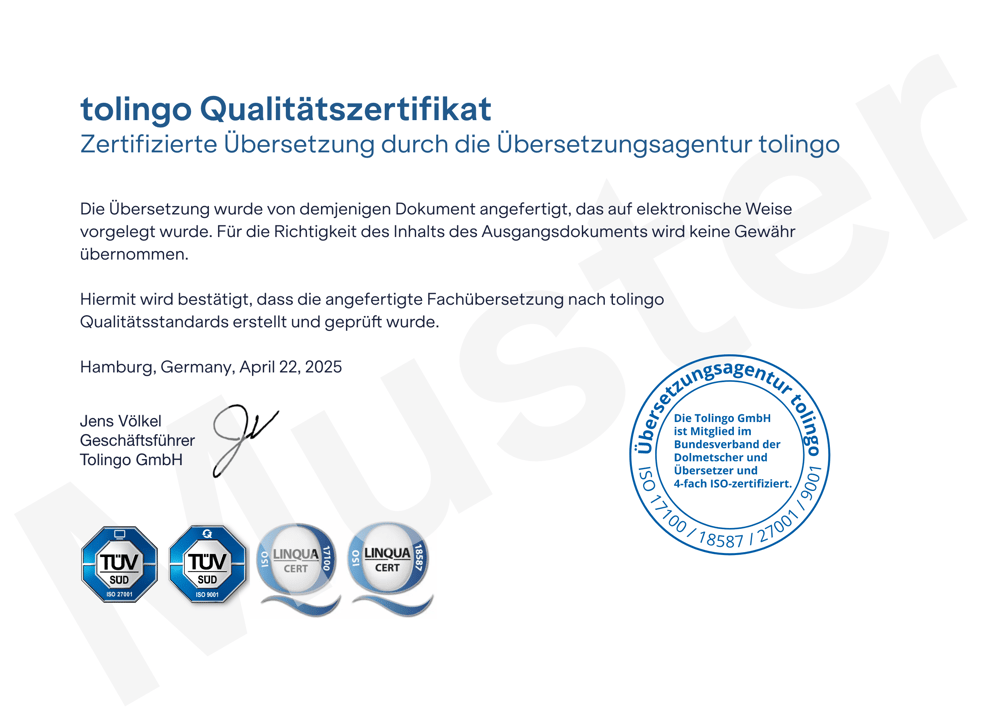
How a translation under ISO 17100 runs.
These five stages describe a specialist translation with revision by a second specialist. Each stage is recorded in the system and every step can be traced. For an audit we can show, on request, who did what to your text and when.
The project manager goes through the text, the subject field, the language pair, the deadline and any existing material such as a translation memory or glossary.
A native-speaking specialist translator from your subject field works in the CAT tool. The translation memory and termbase keep terms consistent.
A second qualified person checks the translation against the original: accuracy, completeness, consistency, terminology, style. Changes are documented.
An automated check on numbers, date formats, tags, placeholders and untranslated segments. On formatted files the DTP team checks the layout.
In the same format as the original: Word stays Word, InDesign stays InDesign, XML stays XML. By download or straight back into your system through the API.
Who does what.
At least three people work on every ISO 17100 project, often four. Each with their own responsibility and their own qualification.
Runs the project from enquiry to delivery, finds the translator and the reviser, settles queries, holds the deadline. Your dedicated contact.
Translates only into their own native language and only within their subject field. Qualified under ISO 17100: a degree, or at least five years of professional experience.
A second person with the same qualification who had no part in the first step. Checks against the original and documents the changes. The actual second pair of eyes.
On texts headed for publication an editor sharpens the flow. On formatted files the DTP team checks layout, line breaks and fonts.
Everyone who works for tolingo goes through a set selection process and is assessed once a year. There is more on that under our translators.
The tools behind the quality.
People do the actual work. In the background, tools hold consistency in place, spot repetitions and catch technical errors before they take up a specialist’s time.
Trados, Across or memoQ. Separates text from layout and shows translator and reviser the same sentence in context.
Stores translated sentences per account. When a sentence comes round again it is already there, and you do not pay for it twice.
Holds your terms in every language. A “Schraube” is a “screw” everywhere, not a screw here and a bolt there.
An automatic check on numbers, tags and placeholders. Optionally a style guide per brand: form of address, tone of voice, preferred wording, things to avoid.
When something needs correcting.
A process with this many checks makes mistakes unlikely, though never impossible. Language is a matter of judgement, and sometimes the client ends up with a different impression from the team. There is a clear route for that.
After delivery you have 35 days to submit substantiated changes or complaints. Within that window we put things right at our cost. Fourteen days is the industry norm.
You speak to your dedicated project manager. They know your project, settle things quickly and bring the translation team back to the text.
Every complaint feeds into the vendor score of the translation team and into our lessons learned process. What went wrong once should not go wrong twice.
Behind this right to corrections sits our quality management certified to ISO 9001: documented complaint, documented resolution, documented improvement. Which standards underpin that is set out in the certification overview.
More on quality and data protection.
Who works for tolingo, how we select them and which dedicated team handles your text.
The four ISO standards in detail: 17100, 18587, 9001 and 27001. With audit history and certificates to download.
EU servers, ISO/IEC 27001, NDAs, and why your content never reaches anyone else’s AI models.
Case studies and feedback from clients who have worked with us for years.
Levels, four eyes, revisers, corrections, audits.
Does every translation go through these five stages?
No. The five stages describe the ISO 17100 level, with the four-eyes principle. Alongside it there are leaner levels such as AI translation (machine translation with light post-editing) or SMART translation (machine translation with full post-editing under ISO 18587). Which level fits depends on the standard the text has to meet, its purpose and the budget. Your project manager will suggest one.
Is the four-eyes principle always included?
In specialist translation under ISO 17100 it is, because the standard requires it and it is part of the price at that level. With full post-editing the human post-editor takes on that role. With plain AI translation and light post-editing there is no four-eyes principle.
Who is the reviser?
A second person with the same qualification as the translator, who had no part in the first translation step. They come to the text fresh and check the translation against the original for accuracy, completeness, consistency and style.
Can we extend the window for corrections?
Thirty-five days is our standard and covers most projects. On longer publication cycles, annual reports or patent specifications for instance, we set the window per project in the quote. Speak to your project manager about it.
Can we get an audit document on request?
Yes. For your supplier audit we provide, on request, a documented process record showing the stations for each job: translator, reviser, QA step, timestamps. If you need a standard-compliant translation with formal evidence, your project manager will set that up with you.
What happens if we are not happy with the translation?
You raise it with your dedicated project manager. The translation team goes back to the text and puts it right at our cost. Every complaint feeds into our vendor assessment and into the lessons learned process under ISO 9001.
What would the process look like for your project?
Send us your enquiry. Your project manager will go through the text and suggest the quality level that fits, with a deadline, a price and the audit options.