
Certified translation agency Our ISO certifications
Only a handful of certified translation agencies worldwide hold four ISO standards at once. tolingo is one of them: a certified translation agency audited by TÜV Süd and LinquaCert. Here you will find every current certificate for direct download, with the scope of each and a short explanation of the standard. Pick the certificate you need below, for a tender, a supplier approval or a compliance file.


 Four ISO certifications
Clients who rely on certified quality

- Scope: specialist translation, workflow management and IT platforms for translation in 220+ language pairs, across every field.
- Certification bodies: TÜV Süd (for ISO 9001 and ISO/IEC 27001) and LinquaCert (for ISO 17100 and ISO 18587), both operating under European accreditation rules.
- Audit history: first certified in 2015 (ISO 17100), annual surveillance audits ever since, re-certification every three years, unbroken since the first certification.
- Downloads: all four current certificates are ready for direct download below. Suitable for tenders, compliance files and supplier approvals.
Every certificate at a glance
Direct downloads for tenders and compliance files
The four current certificates as a single download overview. For tenders or supplier approvals, we can also send a combined PDF pack by email on request.
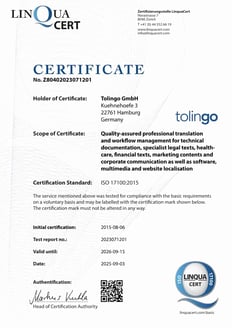
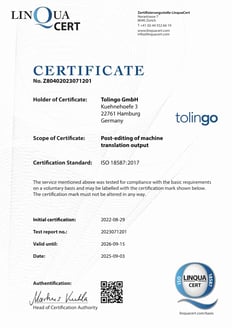
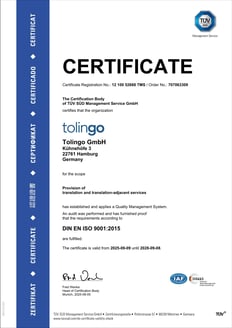
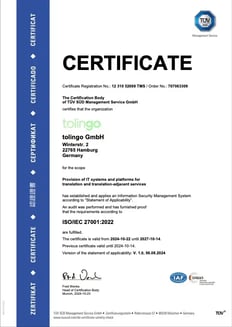
If you need the four certificates as a single combined PDF (for a tender annex, say), we send the pack within ten minutes. A short email to service@tolingo.com or via the contact form is all it takes.
What an ISO certification actually means
Audit process, validity period, consequences
ISO stands for the International Organization for Standardization, founded in 1947 and based in Geneva. It publishes international standards for products, processes and management systems. An ISO certification is not issued by ISO itself, but by accredited certification bodies that check regularly whether a company meets the standard in question.
Certification runs in three steps. In the first audit, the main audit, the certification body checks the entire set of processes, documentation and records against the standard. A passed audit leads to the certificate being issued, usually valid for three years. In the two following years, surveillance audits take place, examining individual aspects on a sample basis. After three years, a re-certification is due, which again amounts to a full main audit.
For tolingo, that means at least four external audits a year, spread across all four standards. Audits can be announced or unannounced. If the certification body finds non-conformities that cannot be remedied, the certificate can be withdrawn. Our internal processes are built so that compliance with the standard stays traceable at all times.
The four certificates in detail
Key facts, scope, what the standard requires, download
Each block covers the key facts, the exact scope, what the standard requires and the download link to the current certificate.
ISO 17100: translation services
First certified: August 2015 · Certification body: LinquaCert · Audit cycle: annual surveillance audit, re-certification every three years
Scope: quality-assured specialist translation and workflow management for technical documentation, legal texts, finance and medical content, marketing and corporate communications, and software, multimedia and website localisation.
Certificate: Download the current certificate →
What the standard requires: ISO 17100 is the international quality standard for translation services and replaced the earlier DIN EN 15038. It sets minimum qualifications for translators (a degree in translation or at least five years of professional experience), requires the four-eyes principle through a second specialist, and governs project management, resource availability, client communication and feedback loops. More on the standard in the glossary.
ISO 18587: post-editing of machine translation
First certified: August 2022 · Certification body: LinquaCert · Audit cycle: annual surveillance audit, re-certification every three years
Scope: full human post-editing of machine translations (machine translation post-editing, MTPE).
Certificate: Download the current certificate →
What the standard requires: ISO 18587 complements ISO 17100 for the special case of machine translation. It sets out the qualifications post-editors must have, how post-editing is documented, and the minimum requirements for output quality. It matters for high volumes with a manageable risk profile. More on the standard in the glossary: MTPE / PEMT.
ISO 9001: quality management system
First certified: September 2016 · Certification body: TÜV Süd · Audit cycle: annual surveillance audit by independent TÜV Süd auditors
Scope: specialist translation and workflow management for technical documentation, legal texts, finance and medical content, marketing and corporate communications, and software, multimedia and website translation.
Certificate: Download the current certificate →
What the standard requires: ISO 9001 is the most significant standard in quality management, nationally and internationally. It calls for a process-oriented approach, documented procedures in every department, continuous improvement, risk analysis and a focus on the customer. It covers producing the translation as much as every other touchpoint: quoting, project coordination, complaint handling, billing, internal reporting. For tolingo clients, that means consistent service quality along the whole value chain, from quote to invoice.
ISO/IEC 27001: information security management system
First certified: September 2018 · Certification body: TÜV Süd · Audit cycle: annual surveillance audit by independent TÜV Süd auditors
Scope: provision of IT systems and IT platforms for translation and translation-related services.
Certificate: Download the current certificate →
What the standard requires: ISO/IEC 27001 is the world's leading standard for information security management systems (ISMS). It defines the technical and organisational requirements for protecting confidential data: physical access controls, encrypted data transfer, documented access rights, regular staff training, contingency management. In the translation industry, tolingo was an early adopter of this standard, which many agencies still lack today. It matters for GDPR-compliant order handling.
Certified without a gap since 2015
The audit history at a glance
Since the first certification in August 2015, tolingo has been certified to at least one ISO standard without interruption, adding three further standards along the way. Annual surveillance audits by TÜV Süd and LinquaCert, re-certification every three years. Every audit so far has been passed, with no break in certification status.
Beyond the ISO standards
Unbroken re-certification, GDPR, sector-specific standards
ISO certifications are the foundation, but not the whole picture. Four further anchors that round out tolingo's compliance profile:
Since the first certification in 2015, tolingo has passed every re-certification and every surveillance audit, with no break in certification status. With four ISO standards running in parallel, each on its own audit cycle, that means at least four external checks a year, sustained for more than a decade.
Beyond ISO 27001, tolingo works to GDPR requirements throughout: documented data-processing agreements with every translator, EU servers, data-deletion policies. More on this: GDPR translations.
For regulated industries such as medicine and life sciences or the defence industry, we build the extra requirements of your regulatory environment (MDR, IVDR, classified-information rules) into our processes, without certifying those standards ourselves.
A contractually assured 35-day correction window on every specialist translation to ISO 17100. The industry norm is 14 days. Details on the quality page.
Common questions about the certifications
Audit process, validity, compliance, languages
Certificates for your compliance files?
If you need documents for a specific tender, supplier approval or internal review, we send the right pack within ten minutes.
Reply in 10 minutes · also available in English