
EU Machinery Regulation 2027: deadlines, changes and a roadmap
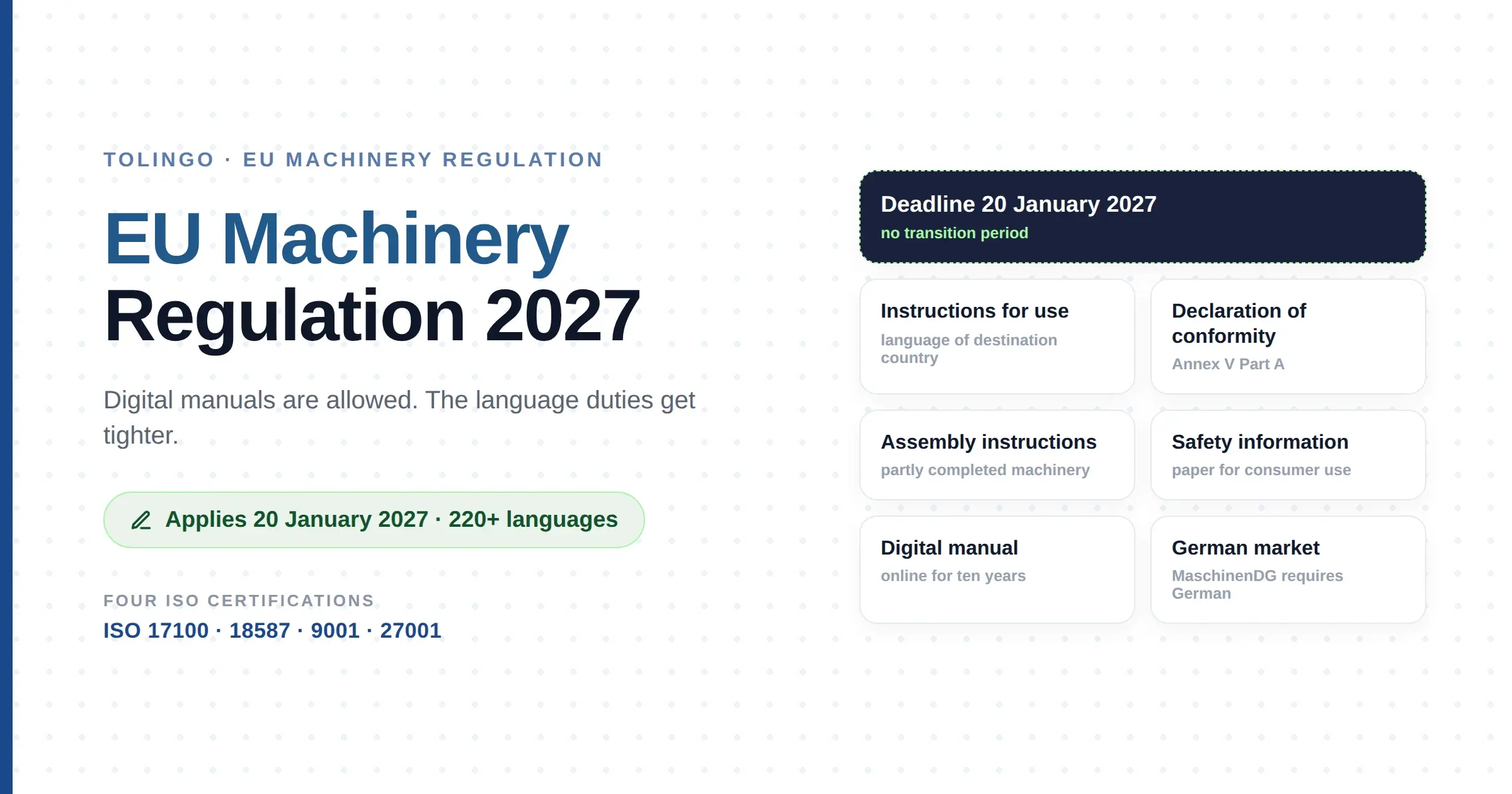
The EU Machinery Regulation (EU) 2023/1230 applies from 20 January 2027, with no phase-in period. This article is the overview: which deadlines apply, what changes compared with Machinery Directive 2006/42/EC, and the order in which to work through your technical documentation before the date. Which document needs which language in which target market is set out in detail on our page on the EU Machinery Regulation and translation, along with a language check in eight questions.
The short version
- What applies: Regulation (EU) 2023/1230 replaces Machinery Directive 2006/42/EC and applies from 20 January 2027. On that date there is no choice between the old rules and the new ones.
- Who it affects: manufacturers, importers, distributors and authorised representatives of machinery, related products and partly completed machinery.
- What is new: digital instructions for use become permitted, the label "original instructions" disappears, and AI safety functions, cybersecurity and autonomous mobile machinery arrive as topics.
- What to do: take stock, pin down the language matrix per target market, clean up the translation memory, build terminology for the new topics. The language check asks eight questions and shows where you stand.
What Regulation (EU) 2023/1230 covers
Regulation (EU) 2023/1230 is the new European framework for machinery safety. It was published in the Official Journal on 29 June 2023, entered into force on 19 July 2023 and applies from 20 January 2027. From that day it replaces Machinery Directive 2006/42/EC in full.
Moving from a directive to a regulation means the rules apply directly in every member state, with no national transposition. National discretion remains only where the regulation allows it, for instance on the language of the documents and on penalties. Machinery placed on the market under the old rules before the cut-off may still be made available.
| Date | What happens |
|---|---|
| 19 July 2023 | Regulation (EU) 2023/1230 enters into force |
| 20 January 2024 | Rules on notifying conformity assessment bodies take effect |
| 6 December 2025 | The German implementing act (MaschinenDG) enters into force |
| 20 October 2026 | Member states have to notify their penalty rules |
| 19 January 2027 | Last day for placing machinery on the market under Directive 2006/42/EC |
| 20 January 2027 | The regulation and the MaschinenDG language rules become binding |
What changes compared with the Machinery Directive
Four changes matter for the technical writing team. Two concern the form of the documentation, two its content.
Digital instructions become permitted
For the first time, the regulation expressly allows the instructions for use to be supplied digitally, for example through a machine-readable code on the machine. That relief comes with conditions: the format has to allow printing, downloading and saving, and the instructions have to stay available online for the expected lifetime of the machine, and at least ten years from the day it was placed on the market.
Two points are easy to miss. First, if the user asks for a paper copy at the time of purchase, the manufacturer has to supply it free of charge within one month. Second, for machinery that may be used by non-professional users, the essential safety information still ships in printed form.
The labelling requirement disappears
Annex III 1.7.4 no longer calls for the wording "original instructions" and "translation of the original instructions". All language versions now sit formally on the same footing, which raises the bar for every single one of them. What that means for the language rules per document type is broken down on the page on the EU Machinery Regulation and translation, with references into the text of the regulation.
AI and autonomous systems arrive
Annex I Part A lists, among other things, safety components with fully or partly self-evolving behaviour that use machine learning and perform safety functions. For these, a notified body has to be involved in the conformity assessment. Annex III adds requirements for autonomous mobile machinery and for human-machine interaction.
Cybersecurity becomes a documentation topic
Protection against corruption in Annex III 1.1.9 is new: manufacturers have to account for the risk of third parties interfering with hardware and software. Software that performs a safety function counts as a safety component in its own right.
These topics bring terms into the documentation that have no settled equivalent in many target languages. Without an agreed termbase, every translator decides afresh whether the German "selbstentwickelndes Verhalten" comes out as self-evolving, self-learning or adaptive. In a warning, that is a liability risk. A list of the new terms is available on the topic page, and how it is maintained over time is described under terminology management.
Germany: what the MaschinenDG adds
The German implementing act fills in the national gaps the regulation leaves open. It repeals the old 9th ProdSV, governs the notification of test bodies, sets out administrative offences and, in Section 2, determines the language of the documents. It has been in force since 6 December 2025, and its language rules apply from 20 January 2027.
For the German market that means the instructions for use, the information required under Annex III, the EU declaration of conformity, the assembly instructions and the EU declaration of incorporation all have to be drawn up in German. Where the instructions are supplied digitally, the note explaining how to reach them has to be in German as well. Breaches of these language rules are listed in the act as administrative offences.
Other member states handle this in their own implementing measures. Anyone exporting to France, Spain or Poland checks those rules separately. An English version rarely does the job there. Which document needs which language version in which market is set out in the overview of language requirements.
Your roadmap to January 2027
There is enough time, as long as taking stock starts now. The work rarely sits in the translation itself, but in going through what has grown over the years.
- Review the document inventory. Which instructions, declarations and safety notices exist in which languages, and how current are they?
- Match target markets to languages. Record the language each destination country requires, including for partly completed machinery.
- Clean up the translation memory. Track down and replace references to Machinery Directive 2006/42/EC, outdated legal terms and the old labelling wording.
- Build terminology for the new topics. Agree the terms for machine learning, autonomous operation and cybersecurity before they turn up in warnings.
- Test the digital delivery. Check that every language version is reachable, printable and downloadable behind the code you have published.
- Define the approval chain. Decide who signs off safety-related passages in the target language, and how that is recorded.
Where do you stand right now? The six steps above also come as a self-check: the language check asks eight questions and shows which points are still open at your company. No email address, about two minutes.
What this means for translation processes
The new requirements mostly affect how language versions are produced and maintained. Three points show up in practice.
A delivery turns into an asset. Digital instructions are not a finished document but a body of content maintained over a decade. Every change to the machine or its software pulls all the language versions along with it. A well-kept translation memory decides whether partial updates stay affordable, because unchanged material is not translated twice.
Terminology comes before translation. Terms such as "protection against corruption" will appear in every language version from 2027. Settle them only once a project is running and ten languages will hand back ten different answers.
The route into translation becomes a factor. Instructions are increasingly written in modules in editorial systems such as Schema ST4, COSIMA or TIM-RS. Through the COTI standard, an API or system integration, changed modules go straight into translation instead of travelling by email.
Which documents tolingo takes on, which level of checking suits each document type and what that costs are all set out on the page on the EU Machinery Regulation and translation. It also carries a worked example of how repetition and the choice of route affect the price.
The next step
If you want to know where your documentation stands, there are two ways. The quick one: the language check, eight questions, about two minutes, result shown straight away. The thorough one: send us a set of instructions for use or a declaration of conformity, and we come back with an assessment of scope, languages and how much can be reused. Request the review, free and with no obligation, first reply in ~10 minutes (within business hours).
Common questions about the roadmap
Which deadlines apply besides 20 January 2027?
The regulation entered into force on 19 July 2023. The rules on notifying conformity assessment bodies have applied since 20 January 2024, and the duty to notify penalty rules since 20 October 2026. The German MaschinenDG has been in force since 6 December 2025, and its language rules apply from 20 January 2027.
Do I have to have all my existing instructions translated from scratch?
Usually not. What makes sense is a review of the inventory: outdated references to Machinery Directive 2006/42/EC, superseded legal terms and the old labelling wording are replaced, and the rest is carried over through the translation memory. The effort is normally well below that of a fresh translation, though only an analysis of the inventory will show how far below.
Where do I start when taking stock?
With the language matrix: which document goes to which target market, and which language that market requires. That tells you which part of the inventory is affected at all. Only then is it worth looking at the translation memory and terminology, because by that point you know which languages actually have to be maintained.
Can AI translate safety-related text?
For warnings, risk assessments and declarations of conformity we recommend translation by specialists followed by revision. For spare parts catalogues, data sheets and parts lists, post-editing to ISO 18587 is a sound and cheaper option.
What changes for suppliers of partly completed machinery?
The assembly instructions and the EU declaration of incorporation have to be in the language of the destination country, so German for Germany. Suppliers who have shipped these documents in English until now pick up additional translation volume as a result. The details, with references, are on the page covering language requirements.
Key terms explained
- Related product
- The regulation's umbrella term for interchangeable equipment, safety components, lifting accessories, chains, ropes, webbing and removable mechanical transmission devices. These products carry the same documentation and language obligations as machinery.
- Partly completed machinery
- An assembly that performs no specific function on its own and only becomes machinery once it is built in. It needs assembly instructions and an EU declaration of incorporation rather than instructions for use.
- Substantial modification
- A physical or digital change made after the product was placed on the market that the manufacturer did not foresee and that affects safety. It can mean the machine legally counts as a new product and the documentation has to be built again.
- CE marking
- The visible sign that the manufacturer declares conformity with the applicable EU rules. It rests on the risk assessment, the technical documentation and the EU declaration of conformity.
- Four-eyes principle
- The procedure under ISO 17100 in which a second qualified person checks the translation against the source text. At tolingo it is part of the premium service and recommended for safety-related text. More under quality and certifications.
Sources
Legal basis: Regulation (EU) 2023/1230 on EUR-Lex and the MaschinenDG at gesetze-im-internet.de, available in German only. This article gives an overview and does not replace a legal review of an individual case.
Related reading
- EU Machinery Regulation and translation: language rules and language check
- Translation for mechanical engineering
- Technical translation
- Terminology management
- Translation memory
- Post-editing to ISO 18587
- Software localisation
- Case study: Becker Sonder-Maschinenbau
- Quality and certifications
- tolingo connect
Written by the tolingo editorial team, technology and industry. Last updated: 3 August 2026. Your contact: Philipp Walzok, service@tolingo.com, 0800 55 133 00.