
Financial communications · 7 min read
Annual report translation: why the decision is made in September
The schedule from award to publication, and the three things that most often cost time in the spring.
Published on 1 September 2026. Editorial team: tolingo GmbH, Hamburg.
In brief
- Annual report translation is awarded in the autumn of the previous year, because capacity from February to April is scarce and the terminology work needs a run-up.
- Ten to fourteen weeks pass between the first translatable draft and publication.
- The three things that cost time in spring are figures that keep moving, terms nobody has decided, and approvals that queue up.
- All three can be settled with a single meeting in autumn. In March each one costs days.
Why the award window sits in autumn
Most companies award the translation of their annual report between September and November of the previous year. That is arithmetic rather than preference. Listed companies publish within weeks of each other from February to April, and the number of translators with an accounting background is finite in that window. Start looking in January and you are looking at a market where the capacity has already been allocated.
The second reason is preparation. A report project sensibly starts with last year's report: it yields a glossary and a translation memory that keep recurring passages consistent. That step needs quiet and a named contact on your side rather than speed. In November you have both. In March you have neither.
If you want to work backwards from your publication date, the stages are set out on our annual report translation page. This article is about what happens between them.
The five stages of a report project
Report projects run in a fixed order, and that order follows how settled the text is rather than the chapter numbering. Whatever is finished gets translated first.
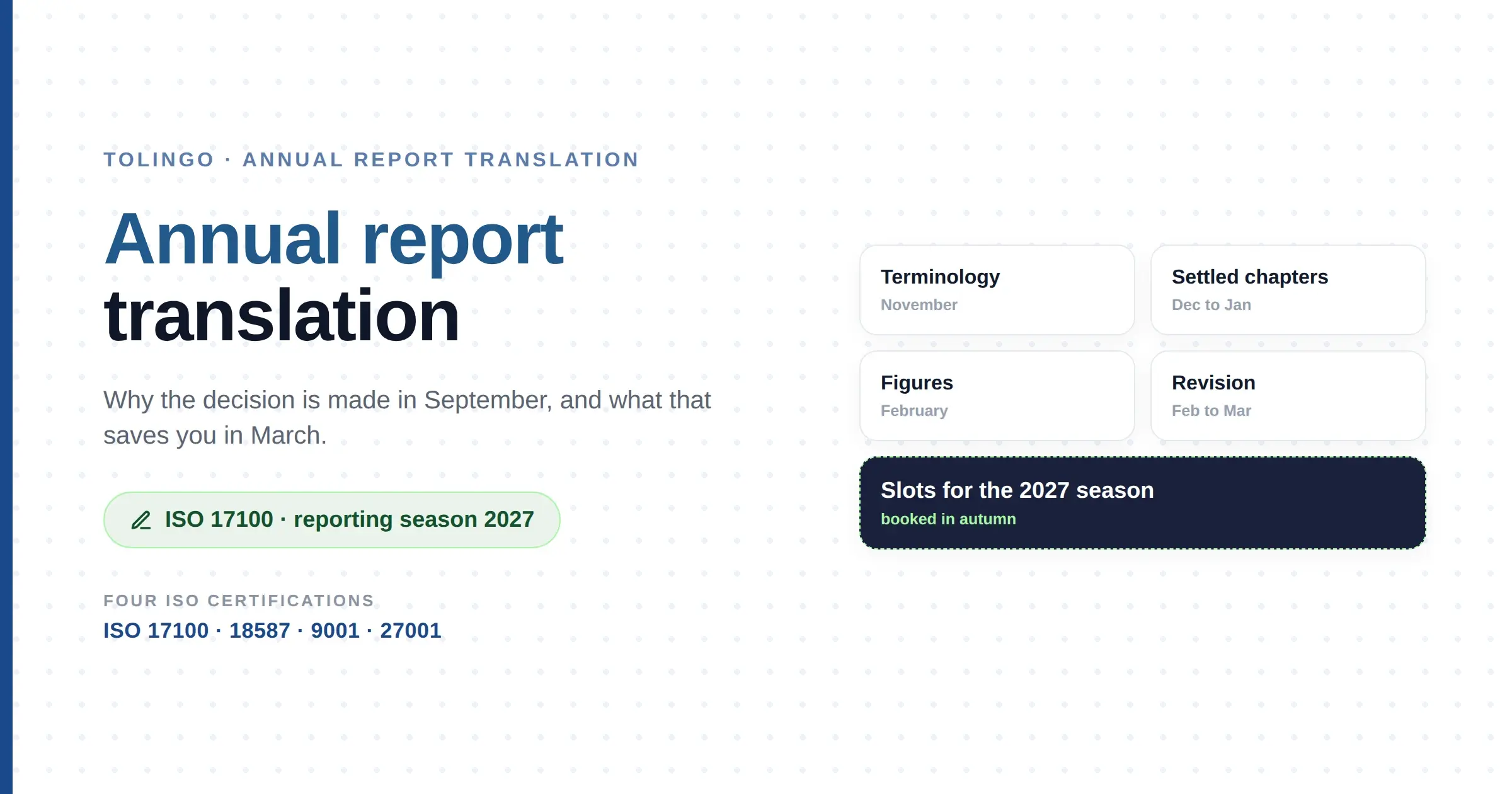
- Award and scope. Volume, target languages, publication date, named contacts on both sides. The output is a schedule with agreed handover dates.
- Terminology. Glossary and translation memory built from last year's report, checked against the wording your corporate communications team already uses.
- Settled chapters. Foreword, strategy, segment descriptions, sustainability section. These rarely change much after the turn of the year.
- Figures and revision. Financial statements and notes, followed by revision by a second specialist. In the Premium service to ISO 17100 that revision is part of the deliverable.
- Layout and approval. Galley proof correction in the typeset version, with a check on number formats, hyphenation and cross-references.
The figures are the shortest stage, even though they get the most respect. The time goes on the foreword, the management report and the sustainability section, the chapters with the most internal authors.
The three things that cost time in spring
Projects that get tight in March almost always have the same three causes. None of them is a translation problem in the narrow sense, and all three can be cleared beforehand.
1. Figures keep moving until late
A late correction in the accounts rarely stays in its table. It reappears in the management report, in the foreword and in the press release. If the new version arrives without markup, the whole file has to be compared again. With tracked changes the same job takes hours.
What helps: an agreement that drafts are handed over with visible change marks, and a version convention everyone understands. Exchange files through a shared platform such as tolingo connect and you have solved this in passing, because nothing gets lost between versions.
2. Terms have not been decided
The most common reason for an extra round of corrections is a terminology decision nobody has taken. Does a segment carry the same English name throughout? Does a performance measure keep its local addition? How are ESRS data points named so that they match the management report? These questions surface during translation, because that is the first time somebody reads both chapters side by side.
What helps: a 45-minute meeting in November that settles the twenty to thirty contested terms. The result is a glossary that also governs press releases, presentations and your wider corporate communications.
3. Approvals run one after another
The board, investor relations, legal and in some companies the auditor all look at the English version. If those reviews run in sequence and each round produces comments, two planned rounds of corrections quickly become four. Each additional round typically costs three to five working days.
What helps: a dated review window in which everyone comments at the same time, and one person who resolves contradictory comments before they come back. Two rounds with clear ownership are faster than four without.
The language versions most reports need
English is the required version in almost every project. Depending on your shareholder base and your sites, French, Spanish or Chinese follow. Further languages run on the same grid, usually a week behind English, because they build on the approved English version.
For notes with a high repetition rate, post-editing to ISO 18587 can be the right treatment. For the foreword and the strategy section it rarely is, because tone and rhythm carry the text there. So the treatment is chosen chapter by chapter rather than for the project as a whole. What that means for the budget is set out under prices and in the description of specialist translation.
Confidentiality shapes the schedule
Until publication the content is price-sensitive and sits under embargo. In practice that means a named, limited group of people, documented access rights and an agreed deletion plan for afterwards. The scheduling consequence is that a fixed group cannot be widened at short notice. If you need extra capacity in March, it has to be built into the plan in autumn.
tolingo is certified to ISO 17100, ISO 18587, ISO 9001 and ISO 27001. For report projects, the relevant parts of the information security standard are access rights, the named group and retention periods. You will find the detail under quality and certifications. The non-disclosure agreement belongs before the first file rather than between two deliveries.
Questions that come up in report projects
When is a chapter ready to translate?
As soon as the content is settled, even if the wording is still being polished. A chapter that is final in substance and still being smoothed can go ahead. Later changes flow through the translation memory and touch only the segments that actually changed.
Who approves the English version internally?
In most companies investor relations together with corporate communications, joined by financial reporting for the accounting passages. What matters is that approval has a named owner. A review group without decision-making authority produces comments, not an approval.
What happens if the publication date moves?
Moving later is straightforward, moving earlier rarely is. That is why the slot is booked against the planned date and shifted if needed, not the other way round. Tell us early and the capacity can be rearranged.
Can several languages run in parallel?
Yes, once the English version is approved. Running them in parallel from the source text is also possible, but then every correction has to be carried into every language separately. A week's offset is faster overall.
Terms
- Annual report
- A company's yearly report, usually made up of the narrative section, the management report, the financial statements with notes and, where required, the sustainability section.
- Management report
- The section alongside the financial statements that sets out performance, risks and outlook. Its terminology has to match both the statements and the sustainability section.
- Embargo
- The period in which price-sensitive content stays with a limited group of people. It determines how a translation team is staffed and how files are handled.
- ISO 27001
- The standard for information security management systems. In a report project what counts is access rights, the named group and documented retention periods.
If you are planning now
The schedule for the 2027 season, with the backward plan, the document types and the option to book a slot, is on our annual report translation page. Last year's report is enough for a first assessment.
The team answers questions about the process under contact.
Last updated: 8 September 2026. Editorial team: tolingo GmbH, Hamburg.