
The short version
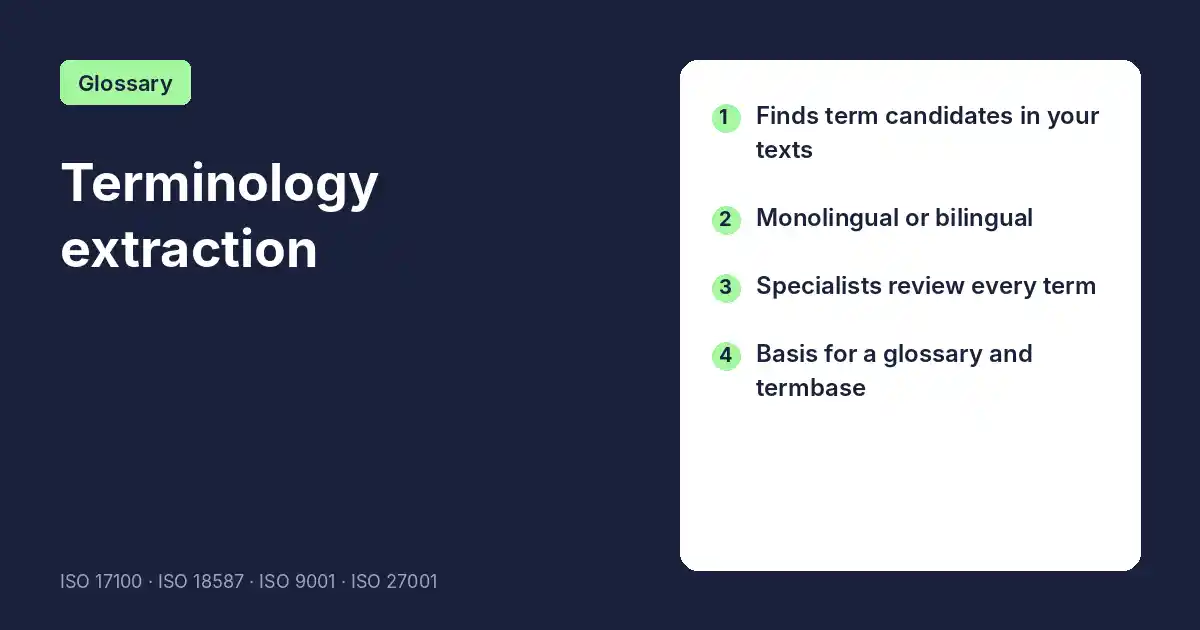
- Terminology extraction pulls the technical terms out of your existing texts, and out of their translations if you want.
- What you get is a list of candidates. They only become binding once specialists have reviewed them.
- Software and AI find candidates quickly. Whether a term applies is decided by people.
- The reviewed terms are the basis for a glossary for your translations.
What is terminology extraction?
Definition: Terminology extraction means systematically identifying the technical terms in your existing texts, and in bilingual texts together with their translations. The result is a list of term candidates that specialists review before they go into a glossary or a termbase.
It is also called term extraction, and it is the first step of any terminology work. Before you decide which terms apply in your company, you need to know which terms your texts actually use.
There are two forms. A monolingual extraction looks at texts in one language only, for example all your German instructions for use. A bilingual extraction looks at source texts and translations together, so you see straight away how each term has been translated so far.
How it works
The software suggests, people decide. How useful the list is depends mostly on the texts you put in.
- Select the texts. Collect current, approved documents from the subject area, with their translations if needed.
- Extract the candidates. A tool looks for words and word combinations that are frequent or typical of the subject.
- Clean up the list. Remove general vocabulary and merge duplicates and spelling variants.
- Review and decide. Specialists choose the preferred terms, add definitions and mark terms you should no longer use.
There are three ways to find candidates, and in practice they are often combined.
| Approach | How it works | Strength and limit |
|---|---|---|
| Statistical | Counts how often words and word groups occur and compares this with general texts | Finds frequent terms reliably, but misses rare, important ones |
| Linguistic | Looks for typical patterns, such as adjective plus noun or compound nouns | Catches multi-word terms, but returns many hits with no technical meaning |
| AI-based | A language model suggests terms and possible translations from the context | Understands context well, but can invent terms or translations |
What this means for your company
An extraction shows you which terms your company actually uses. It does not decide which of them should apply in future. That decision stays with you.
Consistent terms
In documentation that has grown over the years, the same thing often has several names, for example “protective hood”, “cover hood” and “protective cover”. The extraction puts these variants side by side on one list. Then you can decide which term applies and what it is in each target language. The result is more consistency in every language.
Ready for machine translation and AI
Machine translation and language models only translate technical terms consistently if you give them a binding list. A reviewed extraction gives you that list before large volumes are pre-translated by machine.
The right moment
An extraction pays off before bigger projects: a new target language, a product launch, a change of translation provider or a new glossary. Later translations can then be checked against the terms you agreed.
Not to be confused with
Terminology extraction collects candidates. The related terms describe what happens to them afterwards.
| Term | Meaning | Relation to extraction |
|---|---|---|
| Glossary | Reviewed list of technical terms with translations and notes | The result you build from reviewed candidates |
| Terminology management | Ongoing upkeep of terms in all languages | The wider process, in which extraction is one step |
| Alignment | Sentence-by-sentence matching of source text and translation | Works with whole sentences, not single terms |
| Terminology check | Checking a translation against agreed terms | Needs the terms to be agreed first |
Common mistakes
Most problems come from the wrong source texts or from adopting candidates without a review.
| Mistake | What happens |
|---|---|
| Outdated or unapproved texts in the mix | Old terms end up on the list and get used again. |
| Too little text from the subject area | Important but rare terms never show up. |
| Spelling variants not merged | The same term appears several times and gets different translations. |
| Candidates adopted without review | General words and wrong translations become binding. |
Frequently asked questions
What is terminology extraction?
It means identifying the technical terms in your existing texts, and in bilingual texts together with their translations. The result is a list of candidates that specialists review before the terms go into a glossary.
Which texts work best?
Current, approved documents from the subject area the terms are meant for, such as instructions, product data or contracts. For a bilingual extraction you also need the matching translations or a translation memory.
Can AI do the extraction for me?
AI can suggest candidates and possible translations quickly. It cannot decide which term applies in your company, and it can invent terms. You still need specialists to review the list.
What is the difference between monolingual and bilingual extraction?
A monolingual extraction looks at texts in one language and gives you the terms. A bilingual extraction looks at source text and translation together and shows how each term has been translated so far.
What happens to the results?
The reviewed terms go into a glossary or a termbase. At tolingo they are then available to every translator and reviewer in the translation tool, and they belong to you.
Turn your texts into a reviewed glossary
Send us your documents and existing translations. We will show you which technical terms they contain and how they become a glossary for your next projects.
Have a glossary created, first response within about 10 minutes (during business hours).
Related reading
- Glossary or terminology database in the translation workflow
- Terminology management: keep your terms consistent in every language
- Translation memory
This is the English version of our German glossary entry Terminologieextraktion. Written by the tolingo specialist editorial team. Last updated: 27 November 2026.