
You ship the same machine to France, Poland and Germany. That means three markets and three language requirements, and the Machinery Regulation names none of them. The language requirements of the EU Machinery Regulation only become clear once you read Article 10(7) together with the law of each country you supply. This entry shows how that works, where the rules sit and how they compare with the MDR, IVDR and GPSR.
The short version
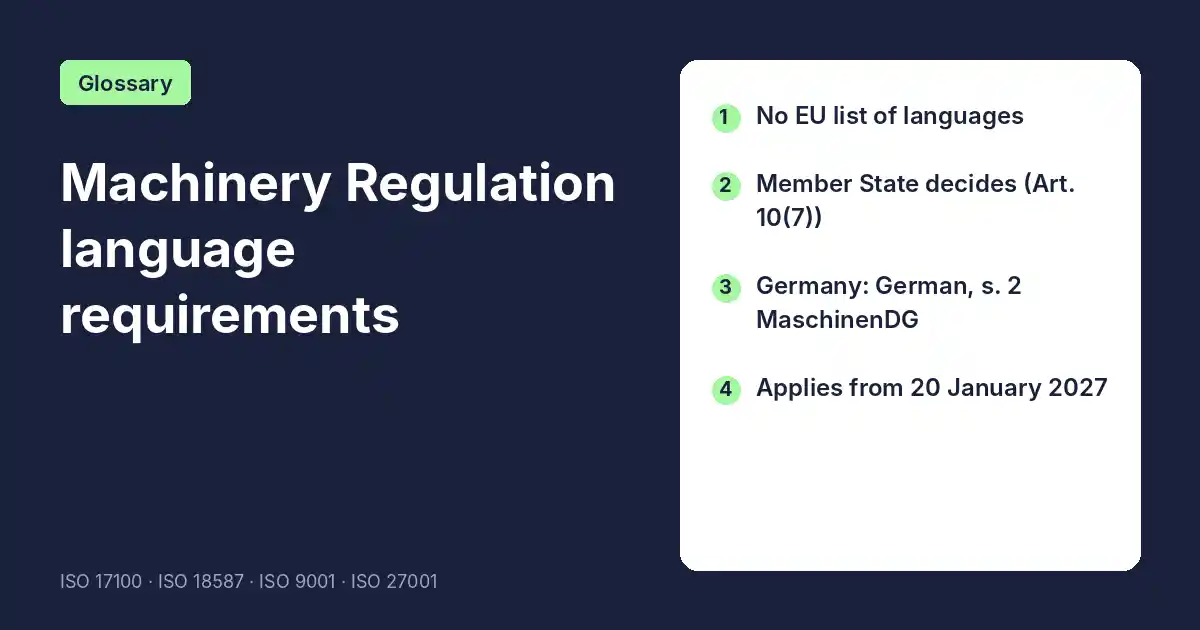
- Regulation (EU) 2023/1230 does not name a language. It asks for the language set by the Member State where you place the machine on the market.
- The key provision is Article 10(7). In Germany, section 2 of the Machinery Regulation Implementation Act (MaschinenDG) sets that language as German.
- It covers instructions for use, safety information, the EU declaration of conformity, assembly instructions and the EU declaration of incorporation.
- The rules apply from 20 January 2027.
What are the language requirements of the EU Machinery Regulation?
Definition: The language requirements of the EU Machinery Regulation (EU) 2023/1230 are the rules on which language your machinery documentation has to be in. Article 10(7) requires instructions for use and safety information in a language that users can easily understand and that the Member State of destination has set. In Germany, section 2 MaschinenDG sets this as German. The rules apply from 20 January 2027.
The Regulation replaces the Machinery Directive 2006/42/EC. Which deadline applies when, and what else changes, is covered in our article on deadlines, changes and a roadmap.
Why there is no list of languages
A regulation normally applies the same way in every Member State. On language, the EU makes a deliberate exception. Belgium, Finland and Cyprus each have more than one official language, and Brussels cannot sensibly decide which one your users understand. So the decision is split in two.
- The Regulation decides who decides. Article 10(7) asks for a language set by the Member State of destination that users can easily understand. It names no language.
- The Member State decides which language. In Germany, section 2 MaschinenDG requires German for instructions for use, safety information and the EU declaration of conformity (subsection 1), and for assembly instructions and the EU declaration of incorporation (subsection 2). Other countries set their rules in their own implementing acts.
For you as an exporter, the answer is never in the Regulation alone. It is in the law of each destination country. Eight markets mean eight national rules to check. Which document needs which language in which market is set out on our page on the EU Machinery Regulation and translation.
Which documents are covered
The language rules are spread across several articles. This table shows where each one sits.
| Document | Reference in (EU) 2023/1230 | Germany (MaschinenDG) |
|---|---|---|
| Instructions for use | Art. 10(7) | s. 2(1) |
| Safety information (Annex III) | Art. 10(7) | s. 2(1) |
| EU declaration of conformity | Art. 21(2) | s. 2(1) |
| Assembly instructions (partly completed machinery) | Art. 11(7) | s. 2(2) |
| EU declaration of incorporation | Art. 22(2) | s. 2(2) |
| Notice on how to access digital instructions | Art. 10(7) | s. 2 |
The last row is easy to miss. If you provide the instructions digitally, for example through a QR code on the machine, the notice telling users how to find them is covered too. An English-only sticker next to the code is not enough for the German market.
Machinery Regulation, MDR, IVDR and GPSR compared
Four EU product regulations contain language rules, and all four work the same way: they require an understandable language and leave the choice to the Member State. Once you know the pattern, you can apply it to any product regulation.
| Regulation | Applies since / from | Language rule | Germany |
|---|---|---|---|
| Machinery Regulation (EU) 2023/1230 | 20 January 2027 | Easily understood language set by the Member State (Art. 10(7)) | German, s. 2 MaschinenDG |
| MDR (EU) 2017/745, medical devices | 26 May 2021 | Language set by the Member State for labelling and instructions for use | German, MPDG |
| IVDR (EU) 2017/746, in vitro diagnostics | 26 May 2022, with staggered transition periods | As in the MDR | German, MPDG |
| GPSR (EU) 2023/988, general product safety | 13 December 2024 | Safety information and warnings in a language consumers easily understand, set by the Member State | German |
So there is no valid language table for EU product law at European level, only one per destination market. If your products fall under more than one of these regulations, for example machinery used in a medical setting, follow the stricter rule.
What this means for your company
The Regulation sets the result, not the method. Your documents have to exist in the required language and be clear, understandable and legible. How you get there is up to you.
- Build a language matrix first. Destination country, required language, document types, existing versions. It shows where the work really is and is the basis for budget and timing.
- Treat every language version as equal. The labels “original instructions” and “translation of the original instructions” no longer apply. Every version stands on its own, so each one has to be right.
- Choose the route per document type. For safety-related text, translation with revision by a second linguist to ISO 17100 is the usual route. For spare parts catalogues and data sheets, post-editing to ISO 18587 is an option.
- Keep your terms consistent. The same term in every document makes instructions clearer. A translation memory and terminology management help, and they also cut the amount you need to translate from scratch.
Often mixed up: EU declaration of conformity and CE marking
The Regulation speaks of the EU declaration of conformity, not a “CE declaration of conformity”. The CE marking is the sign on the product. The declaration is the document behind it, and only the declaration has to be translated.
Frequently asked questions
Is there an EU-wide language rule for machinery documentation?
No. Regulation (EU) 2023/1230 names no language. Article 10(7) asks for the easily understood language set by each Member State, so the answer is always in the law of the destination country. For Germany, that is section 2 MaschinenDG.
How do the Machinery Regulation, MDR, IVDR and GPSR differ on language?
Not in how they work: all four leave the choice to the Member State and tie it to what the users understand. They differ in when they apply, which products they cover and which documents are affected. The Machinery Regulation applies from 20 January 2027, the other three already apply.
What does “easily understood” mean in Article 10(7)?
It is measured against the intended users, not the manufacturer. Instructions for operating staff have to make sense to those staff in wording and structure. Consistent terminology across all your documents helps you meet this.
Is the official language the same as the language set by the Member State?
Not necessarily. The official language is a constitutional term, while the language under Article 10(7) is a product law rule with an added test of whether users understand it. In countries with several official languages, more than one may be required.
Does the notice on how to access digital instructions need translating?
Yes. If you provide the instructions digitally, the notice on how to reach them is covered by the language rules. For the German market it has to be in German. An English-only notice on the machine is not enough.
Which of your documents are affected?
Our free language check asks eight questions about your documentation and shows which points are still open. It takes about two minutes and needs no email address. Start the language check
Sources
Legal basis: Regulation (EU) 2023/1230 on EUR-Lex and the MaschinenDG on gesetze-im-internet.de (in German). This entry gives an overview of the legal position and is not legal advice. It is the English version of our German glossary entry MVO-Sprachanforderungen.
Related reading
- EU Machinery Regulation and translation: language requirements per document type
- EU Machinery Regulation 2027: deadlines, changes and a roadmap
- Machinery Regulation: your translation plan for the final 100 days
Planning your language versions for January? Send us your list of destination countries and one set of instructions. Peer Bosse, Head of Sales, and his team will tell you what is still realistic before the deadline. Head to our contact page, first response within about 10 minutes (during business hours).
Written by the tolingo specialist editorial team. Last updated: 27 November 2026.