
EUDR from 30 December: which supply chain documents need translating
The EU Deforestation Regulation (EU) 2023/1115 applies from 30 December 2026 to medium-sized and large companies. Anyone placing cattle, cocoa, coffee, palm oil, soy, wood or rubber on the EU market needs a due diligence statement from that day, along with the evidence behind it.
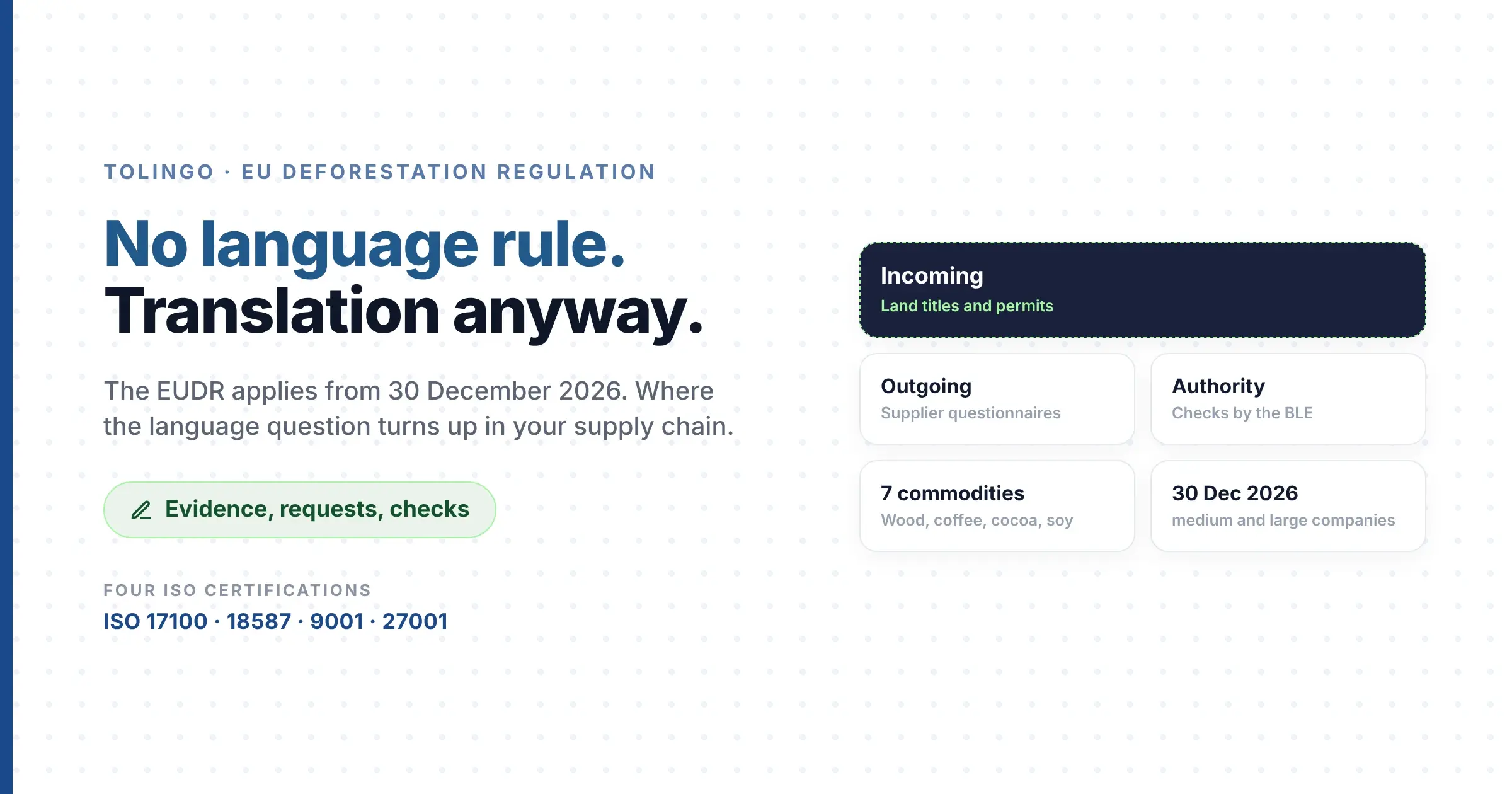
The Regulation says nothing about language. The translation work comes from two other directions: the evidence arriving from the country of production, and the questions you send there. This post sets out both.
This is an account of the legal position, not legal advice.
The short version
- Deadline: 30 December 2026 for medium-sized and large companies, 30 June 2027 for micro and small companies.
- No language requirement: the Regulation names no language for the evidence. The language question arrives through administrative law and through the supply chain.
- Incoming: land titles, concessions, permits and contracts arrive in the language of the country of production.
- Outgoing: supplier questionnaires only come back answered if the producer understands the question.
What has to be in place on 30 December
The Regulation requires a due diligence system in three stages: collect information (Article 9), assess risk (Article 10) and mitigate risk (Article 11). At the end sits the due diligence statement, submitted electronically through the EUDR information system on the TRACES platform.
The Article 9 information covers the description of the product, the CN code, the quantity, the country of production, the geolocation coordinates of the plots, details of suppliers and customers and verifiable evidence that production was deforestation-free and complied with the law of the country of production. That information has to be adequate, accurate and verifiable, and has to be kept for five years.
The second part is the harder one. The Regulation lists the areas of law whose compliance has to be shown: land use rights, environmental protection, forest-related rules, third-party rights, labour rights, human rights and the rules on tax, customs and trade, together with the principle of free, prior and informed consent. It does not say which documents prove any of this. That depends on the country of production, where the paperwork has different names, a different shape and the local language.
What the 2025 revision changed
Regulation (EU) 2025/2650 postponed the start of application a second time and redistributed the obligations. Three points matter for the paperwork.
- Only the operator who first places the product on the market files a due diligence statement. Downstream operators and traders collect the reference numbers of the upstream statements and pass them on.
- A simplified declaration for small primary producers from low-risk countries: once rather than continuously, and the postal address of the production site may replace the geolocation data.
- Risk-based legality checks. Further evidence is only required once the initial assessment points to elevated risk. The Commission’s simplification package of 4 May 2026, with updated guidelines and FAQs, is the reference point for interpretation.
In practice the pile of documents is smaller than under the original version, but it concentrates on the elevated-risk cases. Those are exactly the supply chains furthest from Europe, and the ones least likely to document anything in German or English.
Where the translation work comes from
The EUDR names no language. It asks for verifiable information. Language becomes an issue along three routes.
Incoming evidence from the country of production
Land titles, concession deeds, environmental permits, harvest records, employment contracts and official certificates arrive in Portuguese from Brazil, in Spanish from Colombia or Peru, in Indonesian, Vietnamese or French from West Africa. Someone in your own organisation has to understand what those documents say, because the risk assessment rests on them. A summary in a supplier portal rarely covers it: the assessment has to stand on the document, not on a description of it.
Checks by the competent authority
In Germany the Federal Office for Agriculture and Food (BLE) carries out the checks. German is the language of administrative proceedings, and under section 23 of the German Administrative Procedure Act the authority can require that foreign-language documents be submitted with a translation. Whether it does, and in what form, is decided case by case. Having the key pieces of evidence translated in advance shortens the check considerably.
Outgoing requests to suppliers and producers
The most underestimated point. Geolocation data, plot sizes and legal evidence have to come from farms that are often small and rarely work in English. A questionnaire in English sent to a coffee cooperative in Honduras or a rubber smallholding in Côte d’Ivoire produces queries, delays and, in the end, patchy data. Your response rate depends on whether the question is written in the producer’s working language.
Which documents are typically affected
| Document | Direction | What matters |
|---|---|---|
| Supplier questionnaire and data request | outgoing | the producer’s working language, plain wording, identical questions across all language versions |
| Code of conduct and supplier declaration | outgoing | decide which version is authoritative, keep legal terms consistent |
| Land titles, concessions, lease and use agreements | incoming | specialist translation, sometimes certified when submitted to an authority |
| Environmental and forestry permits | incoming | national forestry law has terms that do not map one to one |
| Certificates and audit reports | incoming | often already in English, which is usually enough |
| Internal procedure for the due diligence system | internal | every language spoken at the sites and buying offices involved |
Not every document needs the same treatment. Certificates and audit reports often arrive in English already. A land title that a risk assessment rests on is a different matter: there the exact wording decides whether the plot is lawfully farmed at all.
What is still achievable before 30 December
Around eleven weeks remain. That is no longer enough to document a supply chain from scratch, but it is enough for the language side if the work starts now.
- October: sort it out. Which countries of production sit in your supply chains, and what language is the paperwork written in? That gives you a short list of languages, usually three to six.
- October: translate what goes out. Questionnaire, data request and supplier declaration into those languages. This is the step that buys the most time, because every week earlier is a week more of responses coming back.
- November: incoming evidence. Translate the documents your risk assessment actually rests on. Not the whole pile.
- December: the version for the authority. For the elevated-risk cases, have the evidence ready in German so that a check does not turn into a translation project.
Micro and small companies have until 30 June 2027 for their own deadline. The requests still reach them now, because their larger customers need the data before December.
How tolingo helps
tolingo works in more than 220 language pairs and is certified to ISO 17100, ISO 18587, ISO 9001 and ISO 27001. Three things count for EUDR documents.
- The right route for each document type. Legal evidence as specialist translation to ISO 17100, with revision by a second qualified linguist. Questionnaires, supplier declarations and recurring text blocks as post-editing to ISO 18587.
- Consistent terms across every language. Deforestation-free, due diligence statement and plot of land should read the same way in every version, otherwise suppliers end up answering different questions. That is what glossary creation and terminology management are for, with reuse handled by a translation memory.
- Confidentiality. Supplier lists and purchasing terms are among the most sensitive data in the business. How we handle them is set out under quality and security.
When something has to move quickly, because a piece of evidence is needed for a check at short notice, there is express translation. Our language overview shows what is covered.
Common questions about the EUDR and language
Does the EUDR say which language the evidence has to be in?
No. The Regulation asks for adequate, accurate and verifiable information but names no language. The language question is practical: it comes from the administrative procedure of the authority doing the checking, and from the fact that your own risk assessment rests on documents somebody has to be able to read.
Do I have to get every document in the supply chain translated?
No, and it would be poor economics. The sensible approach is to select by function: everything that goes out and is meant to come back answered, plus the incoming evidence that a risk assessment or a mitigation measure rests on. Certificates and audit reports are frequently in English already.
Does the evidence need a certified translation?
Not for the due diligence statement itself. Where a foreign document such as a land title or a concession deed is used as evidence before an authority or a court, a certified translation can be required. Check that case by case with the relevant body before having a whole pile certified.
Does the EUDR still apply if my supplier sits in a low-risk country?
Yes. Classification as a low-risk country under Implementing Regulation (EU) 2025/1093 allows simplified due diligence, but it does not remove the obligations. The Article 9 information, geolocation included, still has to be collected.
What changes for traders?
Since the revision, only the operator who first places the product on the market files its own due diligence statement. Downstream traders collect the reference numbers of the upstream statements and pass them on. Translation work there comes mainly from supplier communication and internal procedures.
Terms explained
- Due diligence statement
- Often shortened to DDS. The electronic statement in which an operator confirms it has met its due diligence obligations. It is submitted through the EUDR information system and receives a reference number that downstream stages refer back to.
- EUDR information system
- The European Commission’s platform for submitting statements, technically part of the TRACES system. Access runs through an EU Login and a company registration; importers and exporters also need their EORI number.
- Geolocation
- The geographic coordinates of the plots where the commodity was produced. They are the core of the evidence, because they allow satellite data to show whether deforestation occurred after the cut-off date of 31 December 2020.
Sources
Legal basis: Regulation (EU) 2023/1115 on EUR-Lex, in particular Articles 4 and 8 to 11 and Annex II, as amended by Regulation (EU) 2025/2650, together with Implementing Regulation (EU) 2025/1093 on country classification. Also the European Commission’s simplification package of 4 May 2026, with updated guidelines and FAQs, plus the guidance of the German Federal Office for Agriculture and Food on implementation in Germany. This post gives an overview and does not replace legal assessment of an individual case.
Related reading
- Specialist translation to ISO 17100
- Post-editing to ISO 18587
- Terminology management
- Quality and certifications
- All languages
Which languages sit in your supply chain? Send us your countries of production and one sample document. We will tell you what can still be set up before the end of December. Head to our contact page, first response within ~10 minutes (within business hours).
Written by the tolingo specialist editorial team. Last updated: 8 October 2026.